

The AI landscape has never been more competitive. As we close out November 2025, two major benchmarking platforms—LMArena and OpenRouter—reveal a dramatic shift in the hierarchy of large language models. The race is no longer just between OpenAI and Anthropic; new players are emerging, thinking models are dominating, and the gap between proprietary and open-source is narrowing faster than anyone predicted.
LMArena: The New Gold Standard for Real-World Performance
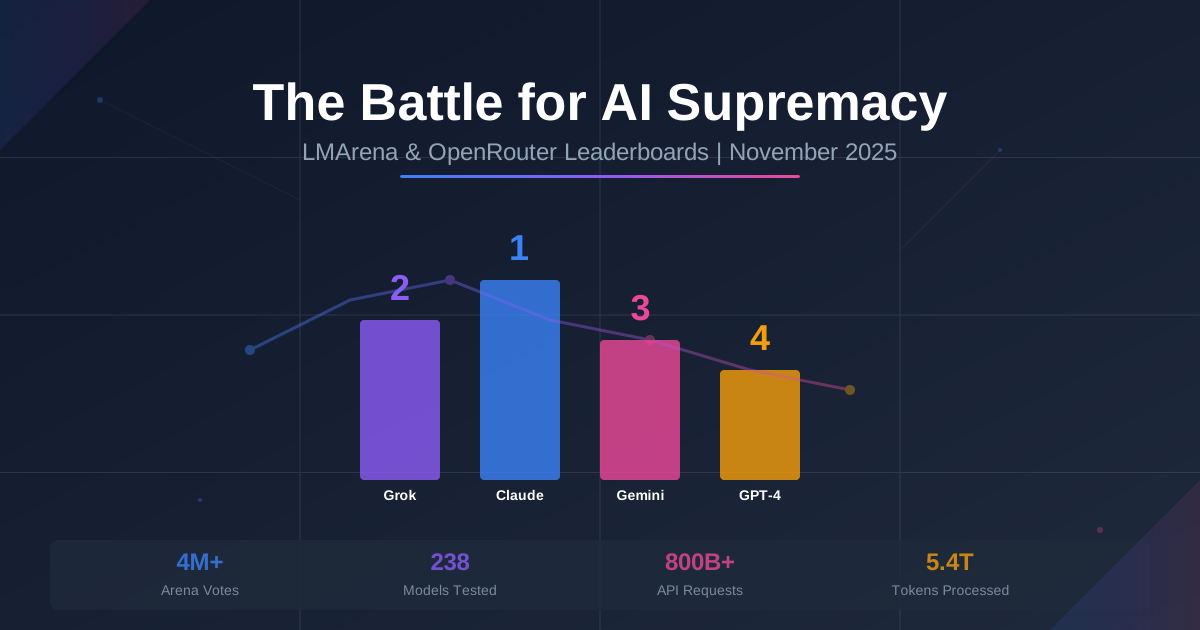
LMArena has established itself as the definitive benchmark for evaluating AI models through blind, side-by-side comparisons. With over 4 million votes in the Text Arena alone across 238 models, it represents the largest crowdsourced evaluation dataset in the industry.
The Current Champions
Text Arena Leadership: Recent additions to the leaderboard paint a clear picture of the current competitive landscape. Claude Opus 4.5 with extended thinking capabilities and Claude Sonnet 4.5 are securing top positions, demonstrating Anthropic’s continued dominance in reasoning tasks. However, they face stiff competition from xAI’s Grok 4.1 thinking variant, which achieved a score of 1483 and is preferred in approximately 65% of blind comparisons.
Google’s recent entry, Gemini 3 Pro, has made waves by achieving first place across multiple LMArena tracks with a score of 1501 in the main Arena leaderboard. This represents a substantial 50-point improvement over its predecessor, signaling that Google has closed the gap with its competitors.
WebDev Arena Insights: The specialized WebDev Arena, which evaluates models on HTML, CSS, JavaScript, and full-stack coding tasks, shows a different picture. With 166,567 total votes, it reveals that GPT-4.1 and Claude Opus 4.1 maintain strong positions, though Gemini 3 Pro scored 1487, outperforming both. Notably, Claude 3.5 Sonnet (October 2024 release) holds position #15 with an Arena Score of 1238.13, based on 26,267 votes.
DeepSeek models, including V3 variants, are demonstrating that open-source alternatives can compete at the frontier level. Their MIT licensing makes them particularly attractive for commercial deployments where model ownership and customization are priorities.
The Thinking Model Revolution
A critical trend emerging from LMArena data is the dominance of models with extended reasoning capabilities. Models appended with “thinking” variants consistently outperform their standard counterparts by significant margins. This suggests that chain-of-thought reasoning and deliberative processing are becoming table stakes for frontier performance.
The Arena Expert category, which represents only 5.5% of the most challenging prompts requiring deep reasoning and specificity, shows even tighter competition. Claude Sonnet 4.5 thinking scored 1510, followed closely by Grok 4.1 thinking at 1509, and Gemini 3 Pro at 1507—effectively a three-way tie when accounting for confidence intervals.
OpenRouter: Market Reality Check
While LMArena measures capability, OpenRouter reveals what developers actually use in production. With completion requests growing from under 100 billion in early 2024 to over 800 billion by January 2025, the platform provides unprecedented insight into real-world deployment patterns.
Usage Leaders vs. Performance Leaders
The disconnect between capability and usage is striking:
By Token Volume (Monthly):
- xAI (2.11 trillion tokens, 38.8% market share)
- Google (1.04 trillion tokens, 19.1%)
- Anthropic (600 billion tokens, 11.0%)
- OpenAI (518 billion tokens, 9.5%)
xAI’s dominance in token consumption is remarkable, particularly given that Grok models only recently achieved top-tier performance. This suggests either aggressive API pricing, integration partnerships, or both.
Top Models by Request Count: Looking at the most-used models reveals a different story. GPT-4o-mini leads with 6.4 million requests (14.4%), followed by Gemini 2.5 Flash at 6.26 million (14.0%). This demonstrates that for many production use cases, smaller, faster, and more cost-effective models still win.
Claude 4.5 Sonnet registers 2.47 million requests (5.6%), while its earlier iteration Claude 4 Sonnet accounts for 952K requests. The combined Anthropic presence suggests strong enterprise adoption, likely driven by perceived safety and instruction-following capabilities.
The Economics of Model Selection
OpenRouter’s rankings illuminate the harsh economic realities of LLM deployment. While Claude Opus 4 may deliver superior outputs on complex reasoning tasks, it can cost 1000x more than efficient alternatives. For high-throughput applications—customer service bots, content moderation, basic Q&A—this premium is unjustifiable.
The rise of models like Gemini 2.5 Flash and GPT-4o-mini in usage statistics reflects a maturation of the market. Teams are learning to route simple queries to cheaper models and reserve expensive frontier models for tasks that truly demand their capabilities.
Strategic Implications for Technical Leaders
1. The Leaderboard Arms Race is Accelerating
The period between November 14 and November 21, 2024, saw Gemini and GPT-4o trading the #1 position multiple times. This rapid turnover suggests providers are actively optimizing for leaderboard performance, potentially testing multiple variants simultaneously before public release.
Recent research has raised concerns about whether this creates perverse incentives. If model providers have access to Arena prompts (either through direct participation or indirect signals), they could fine-tune specifically for leaderboard performance rather than general capability. LMArena’s deduplication measures, which filter out 20% of prompts on average, are attempting to address this, but the arms race continues.
2. Thinking Models Aren’t Free
Extended reasoning models deliver measurably better results on complex tasks, but they come with trade-offs. They’re slower, more expensive, and generate significantly more tokens per response. For production deployments, this means careful consideration of when the juice is worth the squeeze.
The emergence of “thinking” variants across every major provider—from Claude Opus 4.5 Thinking to Grok 4.1 Thinking to DeepSeek-R1—indicates this is becoming a mandatory capability for competitive frontier models.
3. Open Source is Viable at Scale
The presence of DeepSeek V3, Qwen3 variants, and Llama derivatives in the top tiers of both benchmarks demonstrates that the open-source ecosystem has caught up. For organizations with compliance requirements, data sovereignty needs, or heavy customization demands, these models present credible alternatives to proprietary APIs.
4. Occupational Specialization Matters
LMArena’s new Occupational Categories reveal that no single model wins across all domains. Gemini 3 Pro leads in Software & IT Services, Writing, and Mathematical fields, but other models may perform better for Legal, Healthcare, or Creative applications. Production systems should consider domain-specific routing rather than defaulting to the “best” overall model.
Looking Ahead
As 2025 draws to a close, several trends are clear:
The Big Three are Now the Big Four: Anthropic, OpenAI, Google, and xAI all have credible claims to frontier performance. Meta and DeepSeek represent strong open-source alternatives.
Context Length is the New Frontier: Models are shipping with 32K, 128K, and even 200K+ context windows. The ability to process entire codebases, documents, or conversations in a single prompt is becoming standard.
Multimodal is Standard: Text-only models are increasingly niche. Vision capabilities, document understanding, and even video comprehension are expected features.
Pricing Pressure is Real: The gap between premium and budget models is narrowing in capability while the cost difference remains vast. Expect continued price competition, particularly as inference costs decrease and more efficient architectures emerge.
For technical leaders, the message is clear: blind faith in any single provider is a strategic mistake. The tools for rigorous evaluation—LMArena for capability, OpenRouter for usage patterns, and your own domain-specific benchmarks—should inform a portfolio approach to LLM deployment.
The AI race is far from over. If anything, it’s just getting started.
Data sources: LMArena Text, Vision, and WebDev leaderboards; OpenRouter rankings (November 2025). Leaderboards update continuously; check source platforms for latest standings.
#AI #LLM #MachineLearning #GenerativeAI #Claude #ChatGPT #Gemini #AIEngineering #TechLeadership #AIBenchmarks